
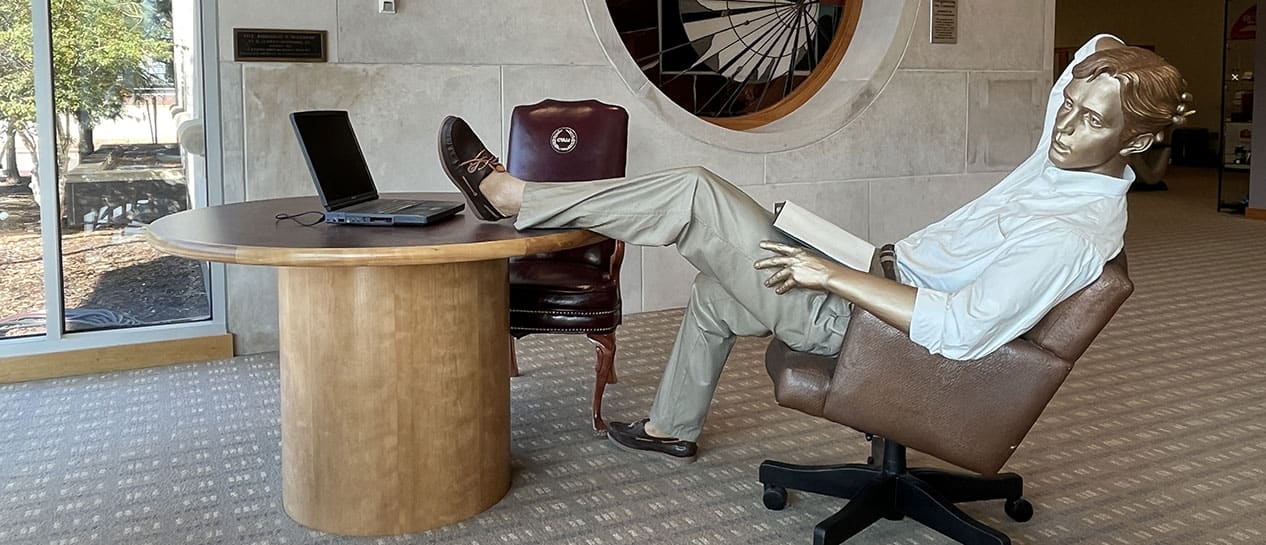
Among the many artifacts, nooks, crannies, sweeping views, wall-mounted plaques, studio operations and stately portraits that adorn the Syndeo Institute at the Cable Center building alongside central Denver’s Buchtel Blvd., my personal favorite has always been “Mike.”
Mike isn’t alive, but he is very real. He’s the carefully sculpted and, although cast from metal, uncannily humanlike figure who has lived almost since the beginning in the institute’s well-appointed Barco Library, casually draping one leg over a chair and immersed, trance-like, in the study of an opened book. Many a visitor to the library here has done a double-take, mistaking Mike for an actual person. Can’t blame them; I have, too.
“Mike” is the building personified. A gift from cable industry impresario Beverly Harms in honor of her late son, he is equal parts student, researcher and curious soul, a reflection of the Syndeo Institute’s deep reservoir of books, magazines, newsletters and archives of the equipment, programming, technology and entrepreneurial verve that gave the industry legs. Here in the library, situated among rows of sturdy shelves, you’ll find thousands of published titles, ranging from author Ken Auletta’s 1992 tour de force book, Three Blind Mice, to Cable Cowboy, the biography of John Malone penned by journalist Mark Robichaux. One row over, the stacks nearly overflow with dozens of databooks and newsletters published by the likes of the analyst firm Paul Kagan Associates, themselves flanking an extensive collection of trade magazines and the venerable industry tabloid Multichannel News. The surrounding décor, meantime, is pure cable. Ted Turner’s well-known “I was cable when cable wasn’t cool” trade advertisement, appropriately framed and prominent, adorns the southeast wall.
The Barco Library is a living testament not only to the wealth of literature and written records chronicling the life and times of the cable industry, but to the colorful (sometimes kitschy) adornments that went along with them. Here, you’ll find a certified MTV Music Video Awards Moonman figurine, a mini refrigerator festooned with the logo of Food Network, and a whole lot more. It’s the what, when and where of a remarkable industry.
lNow seems like an apt time to pay tribute, given that 25 years after its grand opening, the building that houses the library and the broader Syndeo Institute hub is about to undergo a change of hands. The 75,000-square foot collective of real estate ringing the University of Denver campus is slated to be purchased by the university itself, as part of a negotiated changing-of-the-guard that will see the property become part of DU’s extensive array of lecture halls, administrative offices and meeting spaces.
The agreement reflects a changing landscape, but by no means a fading away. Syndeo Institute chairman Michael Willner, himself among the industry’s entrepreneurial patriarchs, calls it a pivotal moment that “positions the Cable Center to serve the industry with greater reach, flexibility and scale at a time when the landscape is evolving rapidly.”
For those – and there are many – who have spent time here, it’s a mixed moment. To be sure, plenty of sentiment surrounds the physical structure itself: home to countless board meetings, industry events, celebrations, seminars, lectures and presentations that have brought thousands of industry luminaries and professionals together in a place they could call their own. At the same time, though, there’s the intoxicating buzz of the new in the air. As the Syndeo Institute team moves into an adjacent space at the DU campus itself, a reimagining is taking place: One in which the organization’s mission is less about maintaining upkeep of a large bricks-and-mortar edifice, and more about a financially disciplined focus on fostering innovation and developing leadership. In a sense, vacating the building that has been an industry fixture since 2001 may feel to some a bit like moving from a childhood home. As your family pulled away from the curb, the feelings were often mixed: the familiar old house receding in the rear-view mirror as the promise of fresh adventure loomed ahead.
President and CEO Diane Christman recently alluded to a similar thought, pointing out that the decision to exit the property reflects an intention of “honoring our past while ensuring The Cable Center can continue to serve the industry and its leaders well into the future.”
The schedule is for the Syndeo team and the Cable Center’s library to be housed for a period of two years within space on the DU campus, with a plan to later identify a permanent location.
The corresponding good news is that the preservation of historical assets goes on, with plans to carefully steward the physical archives and historical collections in a state-of-the-art, climate-controlled facility.
It’s a mission well worth preserving. Almost since the beginning, the Cable Center has offered up a front-row view of the industrial machinery that gave “cable” its lifeblood. Favorites cited by the individual who probably knows better than anyone – the Syndeo Institute librarian and curator Brian Kenny – include a 1960s-era Telemation weather station that offered customers who tuned in to a dedicated cable channel a real-time view of various weather dials –a humble precursor of what would later become cable’s Weather Channel. Another favorite: an old Jerrold Starcom 36 set-top box that demanded its users manually push buttons to select a vertical column coupled with a horizontal row in order to change the channel. “Looks primitive,” Kenny told me. “But did broadcast offer 36 channels? Hell no.” And of course, in homage to cable’s 1990s-era generational transformation, the collection displays some of the very first DOCSIS-compliant cable modems that jump-started today’s broadband economy.
The groundbreaking of the Denver building occurred in 1999, some 14 years after the Cable TV Pioneers organization joined forces with Penn State University to launch a predecessor facility called the National Cable Television Center and Museum. It was 2001 when the original Alan Gerry Cable Center building opened its doors. Since then, the place has served as a wellspring for leadership development, education and collaboration, alongside preservation of cable’s history.
Those precepts and objectives aren’t going anywhere. They’ll carry forward as leaders of the Syndeo Institute work to ensure long-term fiscal stability coupled with ongoing contribution to future innovation. As that transition takes place, here’s hoping our library friend Metal Mike remains on the scene. Pretty sure he’ll love witnessing the next leap forward.
Stewart Schley
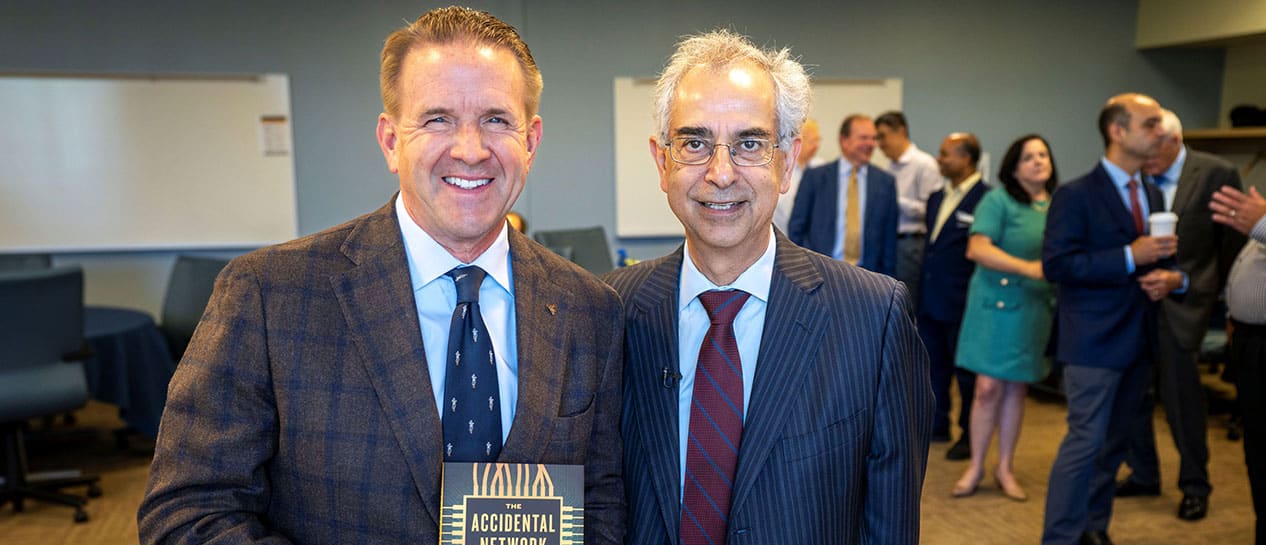
Stewart Schley is a business journalist who has covered the cable communications industry for more than three decades. He is the co-writer of The Accidental Network, the story of the cable modem and pioneering entrepreneur Rouzbeh Yassini-Fard.